Rutherford Lab Presentations at AERA 2023 |
|||
|
First Author or Lab Member
|
Session Info and Links (click any blue titles)
|
||
|
|
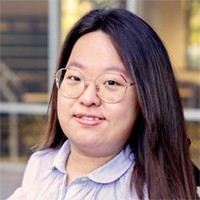
Using Learning Management System Data to Uncover Nuances in College Students' Planning and Procrastination Behaviors Fernando Rodriguez (pictured, UC Irvine), Hye Rin Lee, Teomara Rutherford, Qiujie Li, Amanda Holten We explored nuances in Self-Regulated Learning (SRL) among 427 undergraduate students enrolled in a 10-week introductory Chemistry course. Using course Learning Management System (LMS) click data, we created two indicators of SRL: time management and cramming. Clustering these two indicators revealed five distinct SRL strategies. Interestingly, even students who showed strong planning behaviors tended to engage in cramming. High planning students received the highest course grades.
Thursday, April 13, 9:50-11:20 CDT |
||
|
|
Professional Learning for Transformation? Educational Leaders and a New Teacher Evaluation System Bryan VanGronigen, Coby Meyers, Meg Botello (pictured) This study focuses on one U.S. state’s effort to offer a professional learning support to a group of school- and district-level educational leaders. We used mixed-methods to better understanding whether the Nexus (three state-hired vendors) fostered transformational learning. Findings showed differences in transformational learning through psychological, convictional, and behavioral dimensions, and the Nexus offered some instances of shifts in actions.
Roundtable 10 |
||
|
|
English Language Learners' Language-Integrated Mathematics Game Play and Mathematics Test Scores Ray Patt (pictured), Kerry Duck, Teomara Rutherford Students who are English Language Learners (ELL) are a growing and significant population. Interactions with English in varied contexts, including outside of language arts classes, can support ELL students' academic performance. We find that ELL students who engage with more "language-intensive" mathematics content in a mathematics learning game do not see benefits to their mathematics learning.
Poster 4
|
||
|
|
Expectancies and Values Discussed by Transfer Engineering Students When Providing Advice to Peers Hye Rin Lee (pictured), Kevin Francisco Ramirez, Kaidan Yang, Teomara Rutherford, Jacquelynne S. Eccles Transfer engineering students (n = 39) created peer-advice videos (n = 121) for community college students in engineering courses. These videos revealed that students considered multiple expectancies and values, particularly when discussing their learning goals. These findings are important for higher education institutions and administrators because they provide insight into how to best support engineering students as they make the transition from community college to four-year university.
Virtual Paper Session |
||
|
|
Validity Evidence of a Brief Measure of Mathematics Motivation Kerry Duck (pictured), Teomara Rutherford
We investigate quantitative validity evidence of one a pragmatic brief
Roundtable 12 |
||
|
|
Relationships Between Global and Domain Measures of Self-Efficacy, Emotional Cost, and Achievement in Mathematics Kerry Duck (pictured), Teomara Rutherford We investigated how global and specific mathematics self-efficacy related to performance and to mathematics emotions. The association between global academic self-efficacy and performance was reduced when mathematics expectancy and cost were included in the model; the indirect relation of global self-efficacy and performance through these variables was statistically significant.
Virtual Paper Session |
||
|
|
Self-Regulated Learning in Elementary Mathematics: Presence and Predictors of Slow Down in Problem-Solving After Failure Teomara Rutherford (pictured), Andrew Rodrigues, Kerry Duck Strong self-regulated learner may take failure as a signal that they should adjust their actions to meet their goals. We investigate whether failure triggers one control process—a slowdown in problem-solving—within an elementary mathematics software. We find that fifth graders take longer to solve puzzles after failing that puzzle compared to their first attempt. Personal characteristics moderate the extent of this slowdown.
Saturday, April 15, 2:50-4:20 CDT Swissotel Chicago, Lucerne 3 |
||
 |
About the Rutherford Lab The Rutherford Lab is led by Dr. Teomara (Teya) Rutherford, Associate Professor of Learning Sciences at University of Delaware. Our lab studies the interplay of motivation and cognition in educational contexts: in school and outside of school, in traditional classrooms, and in digital environments. The members of the lab are housed largely within the School of Education at the University of Delaware, although we have collaborations with students and faculty in Computer Science at UD, as well as with those at NC State, UC Irvine, and other institutions. Check out Dr. Rutherford's Google Scholar page for more research. You can read more about our lab
at
rutherfordlab.wordpress.com |
||